So, what’s it like living with a mental illness? – bloggers answer. Part One.

I asked Bloggers to tell me what it was like to live with a mental health condition. Some of these stories are hard to read and I cannot thank the bloggers enough for sharing their stories. Please remember if you need help to contact your GP or the Samaritans on 116 123. You are not alone. 

Emma, @LiterateElf  – Depression

One of the things that still amazes me is how many people think mental health is ‘cute’ or ‘quirky’, without having any greater understanding of how it affects a person. I’ve suffered with issues since my preteen years, and yet I never fully understood what was going on until I hit my early 20s. That’s a long time to be clueless about yourself. Not that I’d say knowing has made any difference, in all seriousness; I became medicated, but that never stopped the depressive episodes. Never prevented me from being escorted by the police on my way to hospital.

I probably paint a bleak picture, but that isn’t my intention, all I want to do is paint an honest one, one that illustrates how individual an experience mental health can be. As I grow older I learn to accept this part of me, while never allowing it to define who I am; I’m more than my mental health. There’s still dark periods in my life, moments where getting out of bed is too great a burden, but they pass eventually, leading to brighter days. It’s hard to offer advice or help to other sufferers, so all I’ll say is that you should try and remember that, while this journey is hard, it’s not always going to be so shitty. You can make it through.

Fears Come to Life (a short story of depression)

 Do you ever feel like you’re teetering on the edge, with the abyss staring back at you, your entire being barely holding on as the engulfing waves wash over you once more. That’s my personal prison that I experience everyday, the minefield of emotions rigged to go off at the slightest unbalance. Try as I might to stem the never-ending tide, I’m always consumed by that which I fear.

Droplets of salt water cascade down my face, splitting apart and splashing my cheeks as they descent to my rounded chin. This is the face that greets me from inside the mirror, her expression blank and cold, sorrow bubbling out of every pore. She should be unfamiliar, but I know her all too well.

I’d seen glimpses of her growing up, a whisper of a form, shrouded in black, but it was never more than fleeting visits. As soon as I’d see her, she was gone, her suffocating aura stolen away along with her. The simplicity of those days weigh down on me now, their irony raw and bitter, just like the pills I swallow to forget the truth of myself.

Stepping away from the reflection, the one I hate to recall so clearly, I lift my form up and into the bath. The water is so warm, stinging as it lightly scolds, red blemishes pricking at my skin. As it washes over me, my being submerged in a metaphorical baptism, I wonder whether my visits from this grave soul, so troubled and shattered, will ever stop.

Opening my eyes under the water, I sense a stirring inside me; she comes for me tonight.

 Anon – Psychosis

“I had a period of psychosis when I was at university. I’m still not sure whether it was brought on by stress (I was in an abusive relationship, was being stalked and my dad was dying at the time) or a severe lack of nutrition (thanks to aforementioned relationship I was existing on a chocolate bar a day and a bowl of rice once a week.) In any case, I was having auditory and visual hallucinations daily; I’d hear people calling my name, see snakes and bugs crawling over the floor and on my skin and occasionally would see and feel branches reaching out to get me, among other things. I told no one at the time, I didn’t feel like I could because of the stigma my family has towards mental illness because of my dad’s mental health problems. I was working full time while at uni and it began to affect my work because I would ask colleagues and customers why they were calling for me and struggled to tell when the voices were in my head and when they were real. Sometimes I couldn’t sleep because I’d be hearing what sounded like a 1950s radio broadcast at night and once I became so convinced that my hands were out to get me that I tried to break my own wrists on my bedpost. I vaguely remember trying to tell people outside of family, but in hindsight I suspect I was so vague about my symptoms that no one really understood what was going on. I haven’t hallucinated since 2014, when I thought that an earthquake was shaking my bed in Seattle, and now I try and avoid the kinds of stress and eating behaviour triggers that used to be constant. I suffered from chronic migraines at the same time so now I’m trying to avoid migraine triggers in case they’re linked. I don’t talk openly about it, and it does mean that I fear that my perception of reality will never be quite trustworthy, but I am able to manage life quite well now.”

Part 2 continues tomorrow with two more bloggers.

If you’d like to share YOUR story email me at chloefmetzger@gmail.com


Q & A Working in Mental Health

IMG_3814

For tonight’s Mental Health Awareness Week post, I spoke to my best friend, Abbie, who coincidentally works for a Mental Health charity. There are a lot of people who can help, but what’s it like to be one of those helpers? I asked Abbie what it’s like to work in Mental Health.

1. What do you do?

I am a Peer Support Coordinator, this means I recruit, train and supervise a team of volunteers who use their own experiences of mental ill health to support others.

2. Why did you choose to work in Mental Health?

I studied Psychology at university and then volunteered in mental health. I’ve also experienced mental health problems myself, so wanted to help others similar to me.

3. What’s one piece of advice you have for people with mental health conditions?

Try to find strength in what you’re going through. For a long time I thought my own mental health challenges could only be a negative, now I use them as a support so that I can help others.

4. What’s one thing you’ve learnt in your job?

People shouldn’t be defined by their history. I’ve worked with people with criminal records, who are incredibly inspiring and have such value to others when they are just given a chance.

5. Is your job affected by government cuts?

Yes! I work for a charity and we are definitely feeling the pinch. We’re also finding it more difficult to work together with other mental health organisations and charities when we’re all competing for ever shrinking pots of money.

6. What should people know about working in mental health?

It can be very challenging but it’s very rewarding. I can be very difficult to work alongside people who are struggling, but it’s amazing when you see them doing well. It’s important to set your own boundaries and know when to take time off to look after yourself.

Thanks to Abbie for giving an insight into her job. If YOU work in mental health and would like to be featured, email me on chloefmetzger@gmail.com!

Legal jargon: All views expressed are Abbie’s own, they do not represent the charity she works for.


10 things you need to know before taking medication for Mental Illness

There is a lot of debate over medication and mental health. As someone who takes medication, I wanted to put together 10 things I feel you should know before taking medication.

  1. It’s not an easy fix – These aren’t ‘happy pills’ as people like to joke. For me, taking medication was similar to a fog rising, it didn’t instantly make me happy but it gave me the strength to make changes and help myself.
  2. Medication isn’t for everyone – It works for some, but not for others
  3. Your body needs time to adjust– In my experience, and that of most people I’ve spoken to, the first few weeks on new medication can have negative side effects. I had a week of feeling really poorly BUT it was worth it. If you can, see if you can get through that period.
  4. If you don’t feel it’s right, go back to your doctor – That said, if you really are struggling and don’t feel you can carry on or after a while feel your medication isn’t working as it should, go speak to your GP. I had three adjustments in a year on the same medication.
  5. You’re not weaker or less of a person for taking medication– There is so much BS about there about not being your ‘real self’ while on medication. If ‘not being my real self’ includes feeling better, not feeling exhausted and unbearably unhappy, I’ll take that, thanks.
  6. There are so many different types! There are so many different types which are used for different symptoms and reasons.
  7. A lot of people are ill-informed, don’t let them scare you – I’ve found two types of people in this category. The first type, people who’ve had a bad experience on medication. I don’t think they mean any harm but no medication is the same for everyone, just because it didn’t work for them, doesn’t mean it won’t work for you. The other type of people don’t know anything about medication and just have, in my personal opinion, uneducated. Do what’s right for you.
  8. You can still have children if you’re on medication – This was something I was really concerned about because there are quite a few side effects and as a woman you have to be extra careful if you want to have children. I have been reliably informed that medication can be managed and monitored, hooray!
  9. You might need to try different medications to find the right one – This happens with a lot of medication, it’s no different when it’s for your mental health. There are so many different types for different issues. Keep going until you find the right one.
  10.  You’re the only person who matters – Everyone has an opinion, but that doesn’t mean they control your life. If you find medication helps you get through the day then you do you, this is your body and your health, no one else’s.

What would you add to this list? Let me know in the comments below or tweet me @chloemetzger

Mental Health, my story so far

IMG_4410

So, to kick start Mental Health Awareness Week I thought I would share with you my own personal mental health journey. I’ve written a lot on this blog about how I live with my mental health, what helps me and some of the not so great times.

If you don’t know me or my blog hello and welcome! I’m Chloe, a 22-year-old blogger, graduate, writer, musician and mental health campaigner. I’ve been living with Depression and Anxiety diagnosed since I was 18 but undiagnosed from around 15 (it took a long time to get a diagnosis).

I’ve had quite a lot of time to think about myself and the fact that I am more than an illness, more than a diagnosis. I struggled throughout my teenage years for a lot of reasons, I was bullied a lot which definitely kick started my illness. I spent a lot of time isolated and desperately unhappy, with no professional help. That was pretty shit. Moving on to college I was slightly better with a new start but still struggling with my mental health, I did have some councilling at the time and sought out my diagnoses, which I got at the age of 18.

Little after that, I went to university after starting my first trial of medication, freaking out and not taking it (not something I’d recommend). I spent my first year pretty sick and being incredibly unhealthy with my mental health, I’d spend days locked in the dark of my room alone, not eating and avoiding people. Towards the end of that year I went back on medication because I was at a really low point, where everyone had noticed.

For my second and third year I was better with the help of my mentor who I had talking therapy with once a week for 3 years. I also started to speak out more about my mental health and working towards educating others, I was also lucky enough to make a speech (watch here) which made my passion even stronger.

I will admit I’ve had a really rough time in the past year since graduating with figuring out who I am, getting used to not having the professional support I had at uni, trying to work on being a graduate and getting used to new doctors (not my fave).

So, that’s a little bit about me. My illness is a part of me, but not all of me. I’m hoping you’re going to enjoy this week. If you have any questions for me drop me a comment below, email me at chloefmetzger@gmail.com, or tweet me @chloemetzger. I can’t wait to hear from you all!

Welcome to Mental Health Awareness Week on chloemetzger.com

Welcome, welcome, welcome! It’s Mental Health Awareness week which I absolutely love because it’s a chance to educate people, share stories and just generally start the conversation. So, because of this I will be posting every day with the theme of mental health, my experiences, the experiences of others and more.

So here it is, Mental Health Awareness Week 2017!

Enjoy!

Mental Health Awareness Week -Sunday Seven: How YOU can help support someone with a mental illness

f14b1d584c6394603c78f487f8a0681e

Here’s my final Mental Health Awareness Week post, enjoy!

Be there 

The most important part of my support system was knowing that people were there for me. It didn’t matter if I spoke to them or not, knowing I could pick up the phone and just have someone be there meant the world.

Ask what would help them 

A lot of people say to me that they don’t know how to help someone who has a mental illness. The easiest way to help someone it ask them what they need, sometimes they might just need someone around or a quiet evening to the cinema or something. If you don’t ask, you’ll never know.

Understand that sometimes people just need to be alone 

On the other hand, sometimes a part of the illness means that you just want to be alone. When I was really struggling I locked myself away from friends because I didn’t want them to see me and I just felt exhausted all the times. It isn’t you, it’s just a part of the illness.

Stand up against stigma

Hear someone making a ‘crazy’ joke? See a stereotype of someone with a mental health condition? Or how about the costumes of a ‘mental patient’ that pop up at halloween? Standing up against these portrayals is one way to help.  Also being an ally to those with a mental health condition by supporting rights and in the media is a way to help.

Don’t treat them differently

There’s nothing worse than being treated differently once you tell people you have an illness. We’re still the same people we were before we told you, you don’t need to tiptoe around us or change our relationship because of it.

Keeping inviting them to things! 

This is my pet hate, even if I’ve been on a low or I’ve not accepted the invite before, you never know when will be the day I feel well enough to say yes! There are tough days, but that’s not every day, this kind of goes with the above.

Remember that no matter what, they’re still them inside. 

Don’t forget that, if nothing else.

Image from Pinterest.


Mental Health Awareness Week : Where I am now?

13122951_10154850662473206_4933877704424103533_o

I’m a very open person when it comes to talking about mental health, I’ll share my ups and my downs and have been online for 3 years now in the hope that it will help others to talk. It’s been raised more than once whether I worry if being so open will hinder my chances of getting a job, something I’ve written about before. I’m a firm believer of using your past to enhance your present and not being ashamed of who you are. I write about mental health often because I refuse to be ashamed of this part of me and I know that it’s just one part of me! I’m so much more than one diagnoses, I’m a daughter, sister, partner, friend, writer, blogger, musician, book reader, former horse rider, world traveller, the list goes on.

I also think it’s important to take stock of how far I’ve come every now and again, because I’m thankful for the opportunities I’ve had. While I’ve been at uni I’ve learnt to deal with depression and anxiety, I’ve learnt methods to stop the thoughts before they get too much. I’ve had jobs that I’ve fallen in love with and have made me genuinely happy and excited to go to work, something I hope to continue. When I started university I wasn’t sure of myself, had very low self confidence and was so, so anxious. I remember trying to go out drinking in a club for the first time and being paralysed with fear, I came home and cried begging to be normal for once. Then in second year I went the opposite way, all my new friends went out a lot and go drunk, I hadn’t had a close group of friends like this so I did that too, even though I was going off of the effects alcohol. It took a long time but now I feel comfortable with myself enough to just tell people I don’t drink  to get drunk, it doesn’t make me happy in the slightest and the people who matter accept this.

When I look at the girl I was on my first day to who I am now I’m impressed with myself. I’ve overcome a lot to get where I am today and that doesn’t mean that I don’t sometimes have days where I’m low and struggling or nights where I can’t sleep because my mind is going 100 mph. With my sessions with my mentor, blogging, living I’ve learnt and am still learning ways to just live alongside my illness, just like anyone else with an illness would. For three years now I’ve tried to notice what makes it better, what makes it worse and when I just need to step back and breathe for a minute.

IMG_3234 (2)

3 years ago the thought of having to get busses and possibly getting lost was enough to send me into a panic attack, this was one of my ways to feel better, sending silly selfies to Ali to make me less anxious. Now I don’t even think twice about busses. 

What I know, and what I want others to know, is that having a mental health condition doesn’t make you any less of a person. Actually, I think what I’ve had to go through has made me a better and stronger person. The hours in A & E when I was a kid checking the bullies hadn’t broken my bones, the sneers from other kids because I was ‘fat, ‘ugly’, a ‘slut’ or ‘couldn’t sing'(none of which were true but to a 15 year old it hurts), the kids who would find my blogs leave comments and then try and embarrass me in class, the fact it was better for my health for me to study from home, the fights, the bruises, everything else they tried to do,  ALL OF IT. People ask if I wish it had never happened, I’ve gotten to the  point now where I think if that hadn’t happened I wouldn’t be the strong, smart, independent woman I am today. If this didn’t happen it might not have triggered my illness, sure but I choose to look at the positives. Being honest and open about my life and experiences has meant that I’ve met incredible people, made amazing friends, won awards, it’s all about what you do with a shitty situation when you’re well enough.

I had rough times, times where I couldn’t see a light at the end of the tunnel and I wondered what was the point. I never want to feel that way again and that’s what drives me. I also want other people not to feel alone and if my blog can show one person that your diagnoses isn’t your life then I’ve done what I wanted to do. Mental illnesses are annoying but they don’t mean that you can’t have a life, it might have to pause for a while but that’s ok, when you’re ready you can take baby steps to put it all back together again.  Right now I’m feeling ok, a little anxious because I don’t know what the future holds but I just remind myself nearly all 3rd years feel that way. All I know is that I’m going back to Basingstoke a different girl to the one who left, one who’s 100% stronger and more kick ass.

Feeling your heart beating – Exercise and Mental Health

IMG_5440

If you’d have told me 5 years ago that I would fall in love with the gym and it would become a kind of therapy I would have laughed at you. I was the clumsy kid who was awful at sports even from the first year of school…I look like a chicken when I run. I also get red, sweaty and gross whenever I do any sort of exercise and so when I tried to go to the gym at my college and beautiful skinny girls were draped over machines posing rather than working out I decided that maybe I wasn’t meant to  do sport, that’s cool. In fact I was more than fine with that fact.

Fast forward to when I found horse riding, I’d been told exercise was really helpful for people with depression but, let me tell you, in my darkest times I just saw myself as a chubby teenager with dodgy knees, you don’t like yourself and you don’t want to be around other people. I basically could go to the school gym, then the college gym, full of kids who couldn’t stand me and the thought of exercising in front of them sent me into a tear filled panic attack at 16. I looked into sports in the first year of university and found nothing that interested me, honestly I think I was so anxious about everything I didn’t let myself even think  about joining a team. By second year I felt more comfortable, signed up for horse riding and fell in love. I worked hard, only ever missing one lesson because I was sick and would always come away feeling lighter. That was a solid 30 minutes of the week where my troubles disappeared I had to work on my body, the horse’s body and making them work together. This was my first taste of exercise making me feel mentally and physically better in a long time.

IMG_1645

When I broke my spine and knew I probably wouldn’t be riding again it broke my heart. Not only had I lost the connection with the horses and my hobby, I’d lost a way to make my mental health better. I was scared, on a lot of painkillers and not ashamed to admit that I did slip back into depression after the accident for a long time. I’d gone from feeling like Jessie the Cowgirl, ready to try jumping and hack across Richmond park in the near future to the news that riding wasn’t going to happen. I still don’t know. It wasn’t until I was fit enough to start going to group physiotherapy in the rehabilitation gym that I found another way to get the hormones pumping and kick my negative thoughts back into gear.

In physio gym no one cares what you look like, everyone has their own struggles and a lot of us had pain while working out. Everything was very slow and most people were 15 years older than me and above. I could try and get into some kind of groove again under the watchful eye of a physiotherapist so my spine didn’t freak out, that was all the way back in November. Now I try and go to the gym weekly, I have the best gym buddy and although I’m still not very fast I’m getting there step by step. I left the gym after a session today with the biggest smile, in part because of my dazzling company and the other because I was covered in sweat and happy that my body had gotten a workout (my back can only sometimes manage a light walk but today, thankfully, was not one of those days.

Feeling my heart beating reminds me I’m going to be ok, just like the Sylvia Plath quote – ‘I am, I am, I am’. Sometimes you just need reminding that your head doesn’t control everything, because on a day here or there it can feel like that. I know that for some reading this, they might not be in a place where they feel they can exercise, getting out of bed is difficult enough and I understand, I’m not here to be preachy, just to say I was like you and keep going. Exercise isn’t going to have this result for everyone and it’s not the only thing I use to keep myself going, it’s’ a combination of talking, writing, exercise, being creative and working… keeping busy.

What helps you guys? Do you exercise or spend time doing something else? Let me know!


Be sure to check out my other posts for Mental Health Awareness Week on the home page!

Todays mood update: Tired and a little overwhelmed this afternoon due to a flat visit but right now I’m feeling pretty chilled out and happy, the gym session obviously worked!

Mental Health Awareness Week: The Medication Debate

2306fa21e584b3b559c859b96fd891cc

Medication is a huge debate whether you have a mental illness or not. It’s something that definitely needs to be spoken about more, in fact I think it’s one of the biggest reasons that people are reluctant to talk about mental illness. There are some people that are of the opinion that those who take medication are taking the ‘easy way out’ or mean that people don’t want to try, as someone with experience neither of these are true. The other extreme belief is that all medication turns you into a zombie, someone who can’t think or do anything for themselves, again an image of simply giving up.

From my own personal experience and the experience of every single person I’ve spoken to about medication it is definitely NOT the easiest solution. While it’s right to say that medication is not for everyone  and some people don’t want to take them, that’s fine. For me I’d tried so many other things counselling being the main route, trying to sleep properly, nothing was working. I was emotionally and physically exhausted when a doctor asked me if I just wanted to try and see how it goes, because I looked completely at the end of my teather. That was the first time and I freaked out about the stigma surrounding them and I just quit, I was done. Then a while later I got at a low stage again and decided to give it a go, the side effects were horrendous. I didn’t sleep for three days, I felt sick all the time, I was sick, I called my doctor to ask if this was normal (it was my first experience of insomnia) who said give it a few more days and see. Luckily this time I carried on, after a few adjustments, reviews and such I eventually settled.

There are a lot of horror stories and it’s rare for someone to go on medication and it be right for them instantly. There’s usually a lot of adjustments, a lot of change. A lot of people ask me why, why put this in your body? For a long time I struggled, who was I, why did my stupid body need these tablets? I really beat myself up constantly. I didn’t want to be someone who relied on medication to function, I didn’t feel normal. That said I could see changed after about a month, it’s hard to describe online, hell it’s even hard to describe in person. It’s like for a long time I was walking around with this fog in my head, everything I did felt wrong, heavy and even when I was happy there was something in me that constantly tugged at my happiness. When the medication worked I wasn’t fixed, but the fog cleared and I could finally think and see things clearer. After I took my medication I started to go back to who I was before the depression took hold of me and I started trusting myself again.

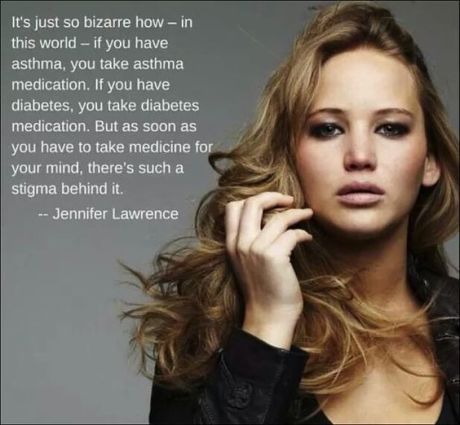
It took a long time but my mentor reminded me of this quote:

7ac9b9735fc67e455c5aa68099cbb73d

I wasn’t scared of the medication, it helped me after years of just feeling like I was drowning I had some calmness. No one would ever dream of telling a diabetic not to take insulin because of the fact ‘it changes their body’ well, yeah that’s the point. While there are some negative aspects of medication and again, it’s not for everyone BUT it can help. Who has the right to dictate whether or not someone should take something if it does make them feel better, if it enables them to tackle the day or makes the tough days a little bit easier.

It’s the same for me with anything medical, if it’s not your body then you can’t really dictate anything. I truly believe that unless you’ve been through something you can’t judge someone else. Stigma related to taking a medication that makes you well doesn’t really make any sense to me. Like I said, it’s not the easy way out, a quick fix or anything like that without going to see a mentor once a week for a long time my medication wouldn’t have been very effective. People need to work through their problems or the root cause of their depression, sometimes medication makes it a little clearer and a little easier to talk about.

I refuse to be ashamed of treatment for a health condition, neither should you.


As always let me know your comments, questions and just generally chat below!


Today’s MH Update: Felt a little overwhelmed today and did have a bit of a crumble BUT now feeling very positive and happier!


Images from Pinterest

Mental Health Awareness Week 2016 on chloemetzger.com

MHAW

This week is Mental Health Awareness Week, as my regular readers know I’m really big on promoting awareness, sharing my own experiences with mental health and just generally getting mental health in every day conversation. Whether we like it or not there’s still a stigma attached to mental health issues and it’s not the way it should be BUT with weeks like this we can end the stigma sooner rather than later.

This week I’ve decided to relate all my posts to raising awareness of mental health. I’ve got posts planned around my experience, opinions, books related to mental health, motivation – it’s all going to be going on over here! As always I’d love to hear for you in the comments, on Twitter. I’ve found that when I’m really not doing well Twitter is one of the places I can talk to people to understand and generally be in a better mood.

I also want to do an honest mood update each day, because sometimes I can go a few weeks of feeling fine and then it’ll go downhill, it’s the ways of having Depression. For today I’ve been really sleep deprived so my mood hasn’t been the best, I’m at a really overwhelming point in my life and everything’s changing so I think that’s to be expected.

I can’t wait to write this week and raise as much awareness as possible! As always leave comments and questions below!